Agentic AI · Module 22
Why safety layers matter (and how they’re built)
Autonomous agents can act on the world. The interesting engineering problem is bounding what they do, with what evidence, under whose authorisation.
Permit chokepoint
Every autonomous action must pass a fail-closed permit check before execution.
Dry-run mode
New action types simulate for 30 days; nothing ships to the real world.
Audit log
Every attempted action is recorded before it executes.
Anomaly detection
A continuous adversarial check observes the audit log for drift.
Kill switch
Operator can disable all autonomy with one toggle.
Applied frame
Convert capability into a bounded work loop with tools, memory, permits, review, and audit.
Diagram cue
The diagram keeps autonomy wrapped in observable control points.
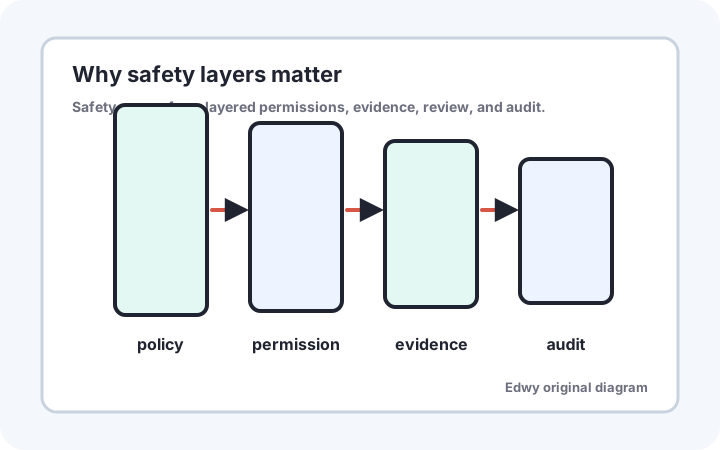
Safety comes from layered permissions, evidence, review, and audit. Key motion beats: policy, permission, evidence, audit.
Safety layers check
0 of 1 questions completed locally.
Source slide 23